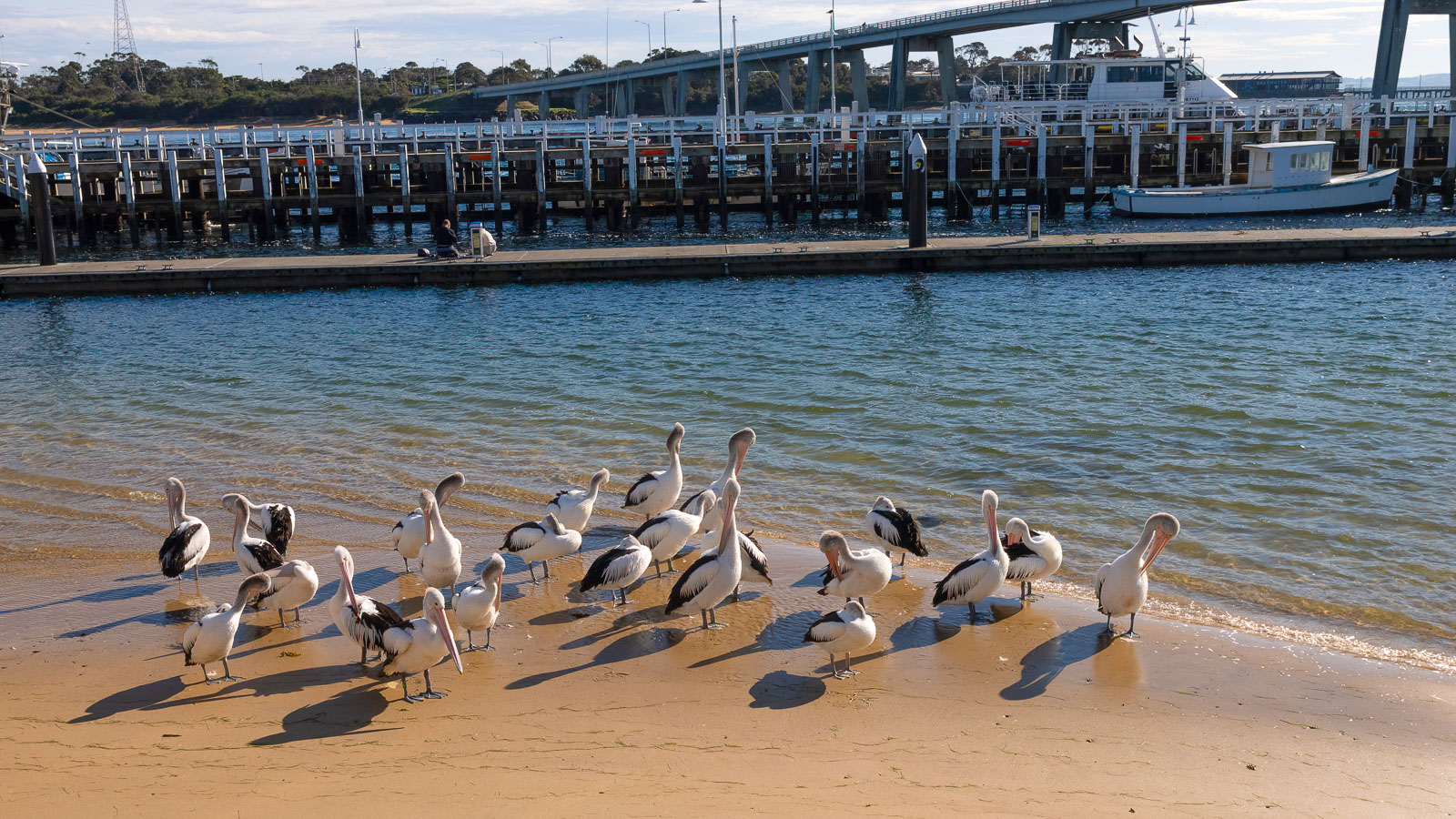
Australian pelicans
In Victoria, there’s a lovely little coastal town called San Remo — the Australian namesake of the certain Italian town. I’ve got no idea what goes on in the Italian San Remo, but the Aussie version is famous for fishing, taking tourists out on boat trips, and feeding pelicans.
For more than 50 years, there’s been a daily pelican feeding tradition. The local Fish Co-op, which is also well known for serving excellent fish and chips, takes care of it. Every day, right on midday, one of the staff members strolls down to the foreshore carrying a crate of fish scraps and tosses them to the waiting pelicans.
The pelicans start gathering shortly before noon. Then comes the real entertainment: a noisy, feathery argument over who has the strongest claim to the free fish. The resulting commotion provides plenty of amusement for the crowd.
People actually travel here specifically to watch the spectacle. Fair enough — everyone knows the feeding happens at 12 o’clock. What I can’t work out is how the pelicans manage to show up exactly on schedule every single day. How on earth do they know the time?
I’ve watched the feeding several times now and finally decided it was worth filming. The footage turned out quite nicely, and once again I shot it in HDR. Unfortunately, I completely dropped the ball when it came to the audio.
It never occurred to me to bring an external microphone with one of those furry wind covers that block out wind noise. Incidentally, those furry covers are officially called a “Dead Cat”. Seriously — that’s the professional term!
So, thanks to the absence of both a microphone and a Dead Cat, the audio ended up being recorded by the camera’s built-in microphones. The result: a rather unpleasant amount of wind noise. Not much you can do about that now.
Anyway, here are the pelicans:
A few fun facts about pelicans.
Australian pelicans are among the largest flying birds in the world. They can weigh up to 7 kilograms and have wingspans reaching 2.6 metres. They’re found all across Australia, as well as in Papua New Guinea and Indonesia.
They also hold the world record for the longest bird bill, which can reach an impressive 50 centimetres. Beneath the bill is a stretchy pouch capable of holding up to 13 litres of water — along with any fish caught in the process. The water gets tipped out, the fish gets swallowed.
Interestingly, pelicans are team players when it comes to fishing. They often work together, herding fish into shallow water before scooping them up with their enormous bills.
Those bills are remarkably versatile. They also help cool the birds down in hot weather and even assist with filtering seawater. That’s right — pelicans can drink seawater because specialised glands remove excess salt from their bodies.
They’re also exceptional flyers. Rather than flapping constantly like many birds, pelicans soar on rising air currents much like gliders. They can climb to altitudes of around 3,000 metres and stay airborne for up to 24 hours without a single wingbeat. That ability allows them to travel thousands of kilometres deep into the Australian outback.
They really are wonderful birds. Funny and charming, awkward and graceful at the same time. They remind me of giant seaplanes, especially when they come in to land. Watching them is always a pleasure.
So have a look for yourself:


And here’s a photo of the bridge at San Remo. It has absolutely nothing to do with pelicans, but as you can imagine, there was no way I was walking past it without taking a photo.


You can find the high-resolution version in my Flickr album:
Leave a Reply