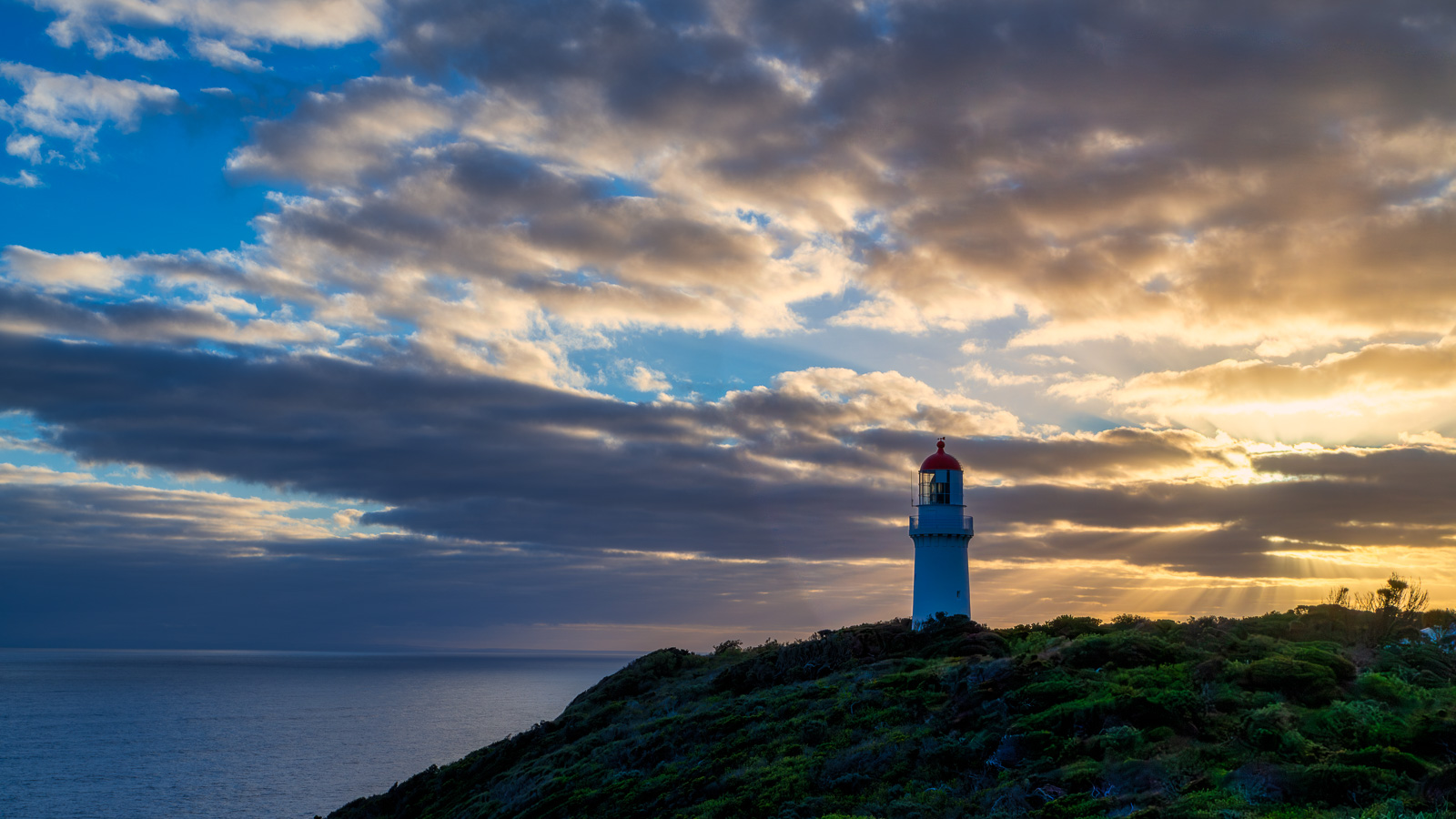
Cape Schanck Lighthouse
Victoria’s coastline is dotted with lighthouses—and for good reason. These waters have always been treacherous, and back in the days of sailing ships, wrecks were a regular occurrence. In fact, the coast is scattered with the remains of ships that never made it home. That’s why building lighthouses and producing accurate navigation charts was such a big priority back in the 1800s.
One of those lighthouses was built at Cape Schanck. The cape was named after the Scottish naval engineer Captain (later Admiral) John Schank (1740–1823). The funny part? Someone managed to spell his name wrong. His surname was Schank, but the cape ended up being recorded as Schanck—and that’s the spelling that stuck.
Cape Schanck marks the southernmost tip of the Mornington Peninsula, so having a lighthouse here was pretty much essential. It was completed in 1859, becoming only the second lighthouse built in Victoria.

The light first shone on 30 June 1859, and here’s the remarkable bit—it has lit up every single night since. Not one missed night in more than 160 years.
The lamp has been upgraded over the years, but the beautiful Fresnel lens, made in England by Chance Brothers, has been in service since 1915.
The heavy 1915 lens apparatus does not sit on mechanical rollers; instead, it floats effortlessly on a bed of liquid mercury to minimize friction. It sounds a bit crazy, but it’s an elegant engineering solution that lets the lens turn smoothly and reliably.
The current 1,000-kilowatt lamp has an intensity of around one million candelas and can be seen from as far as 27 nautical miles (about 48 kilometres). Depending on which direction you’re looking from, it flashes either red or white, transmitting the Morse code letter “N”.

Since 1987 the lighthouse has been fully automated, and no longer requires resident keepers. Before that, three lighthouse keeper families called this place home. It was an incredibly isolated posting, with supplies arriving only twice a year. Luckily, they could also buy fresh produce from nearby farmers.
These days it’s a fantastic place to visit. There’s a large car park, toilets, viewing platforms and well-maintained walking tracks. The coastline here is rugged, wild and absolutely stunning, and the lighthouse gives it that extra touch of old-world maritime charm.
It’s no surprise Cape Schanck is hugely popular with visitors, especially photographers. I’d say just about every Melbourne landscape photographer has been here at least once. I’ve probably made the trip ten times myself.
Strangely enough, though, I’d never been here for sunset. That little oversight has finally been corrected.
Here are a few shots from the evening.


Do yourself a favour and have a look through the Flickr album—preferably on the biggest screen you’ve got.
https://www.flickr.com/gp/147740420@N06/1A424p73cP
My Nikon D850 might not be the latest camera anymore, but it’s still an absolute beast. I usually shoot at half the sensor’s resolution, which is still enough for 4K images. This time I decided to go all out.
These photos were captured at the camera’s full resolution, and I processed the originals as 8K images (not every shot in the album though). Flickr supports uploads up to 6K, which is still massive. In other words, these are huge, ultra-high-resolution photos.
And for the photography geeks: they’re processed from the original 14-bit raw files in the Adobe RGB (1998) colour space.
I’ve also included a drone video I shot here a few years ago.
Leave a Reply