Churchill Island
Churchill Island
No, not that Churchill. This island’s named after a completely different bloke, who also managed to leave his mark on history.
Churchill Island sits right next to Phillip Island in Victoria, about 125 km from Melbourne. It’s separated from Phillip Island by a narrow channel and joined to it by a skinny bridge that two cars definitely can’t pass on at once. As you’d expect, I went out there, took a heap of photos, and a photo report follows.

Let’s start with a bit of history. The island was first spotted in 1798 during George Bass’s expedition, but it didn’t get its name until 1801. That honour went to Lieutenant James Grant, who was charting this stretch of coastline aboard the Lady Nelson on behalf of the British government.
The island was named after John Churchill, a farmer from the town of Dawlish in Devon. John had supplied the expedition with seeds, and Lieutenant Grant named the island as a way of saying thanks.
That gift turned out to be a fairly big deal, because Grant and his crew ended up making a long stopover on Churchill Island. They cleared a patch of fertile land, planted the seeds and put up a few log huts. Both of those went down in the history books as the first agricultural work and the first buildings put up by Europeans in what’s now Victoria.
Permanent settlement on the island didn’t really happen until the 1850s. It was too small to support much more than a single farming family at a time. The farm and the island changed hands a few times until 1872, when it was bought by Samuel Amess, a wealthy stonemason and former Mayor of Melbourne. He was after a summer retreat for the family, but he didn’t neglect the farm either.


The Amess family built a proper little homestead and a lovely garden, and enjoyed having their own private island right up until 1929. After that it passed through a few more private owners, until the Victorian Government bought it in 1976 and turned it into a national park to preserve its history.
The homestead and farm have since been restored and opened up to the public. These days, for just $17.50, anyone can visit the island and get a look at how a typical 19th-century farm actually operated.
It’s obviously more of a kids’ thing, but the whole family gets a kick out of it. There’s a handful of staff on the farm demonstrating everyday farm tasks, everything from blacksmithing to four-handed piano playing.
Anyway, here’s what I managed to capture.
The farm keeps a good range of animals: horses, cows, goats, sheep, rabbits, chooks, ducks and geese.


To handle the not-so-bright sheep, the farm’s got a very clever dog named Hammer. Hammer is a highly trained working dog who knows exactly how to muster sheep, and dogs like him are worth their weight in gold to farmers. Right now Hammer’s at the peak of his performing career, showing off his skills to the crowd.


Next up was a whip-cracking demo. Turns out there’s a proper science to it, with all sorts of different whips built for different jobs. The bloke running the show demonstrated his skills, then had a go at teaching anyone keen to try.
Families are the main visitors to Churchill Island, and this bit’s really aimed at the dads. Many of the fathers lined up to have a crack at whip-cracking like proper cowboys.


After that came the sheep-shearing demo. Turns out being a sheep’s hairdresser is no easy gig.


Then we dropped into the Amess family home. It’s a pretty typical house for a well-off Australian/British family of the era, kitted out with authentic 19th-century furnishings.


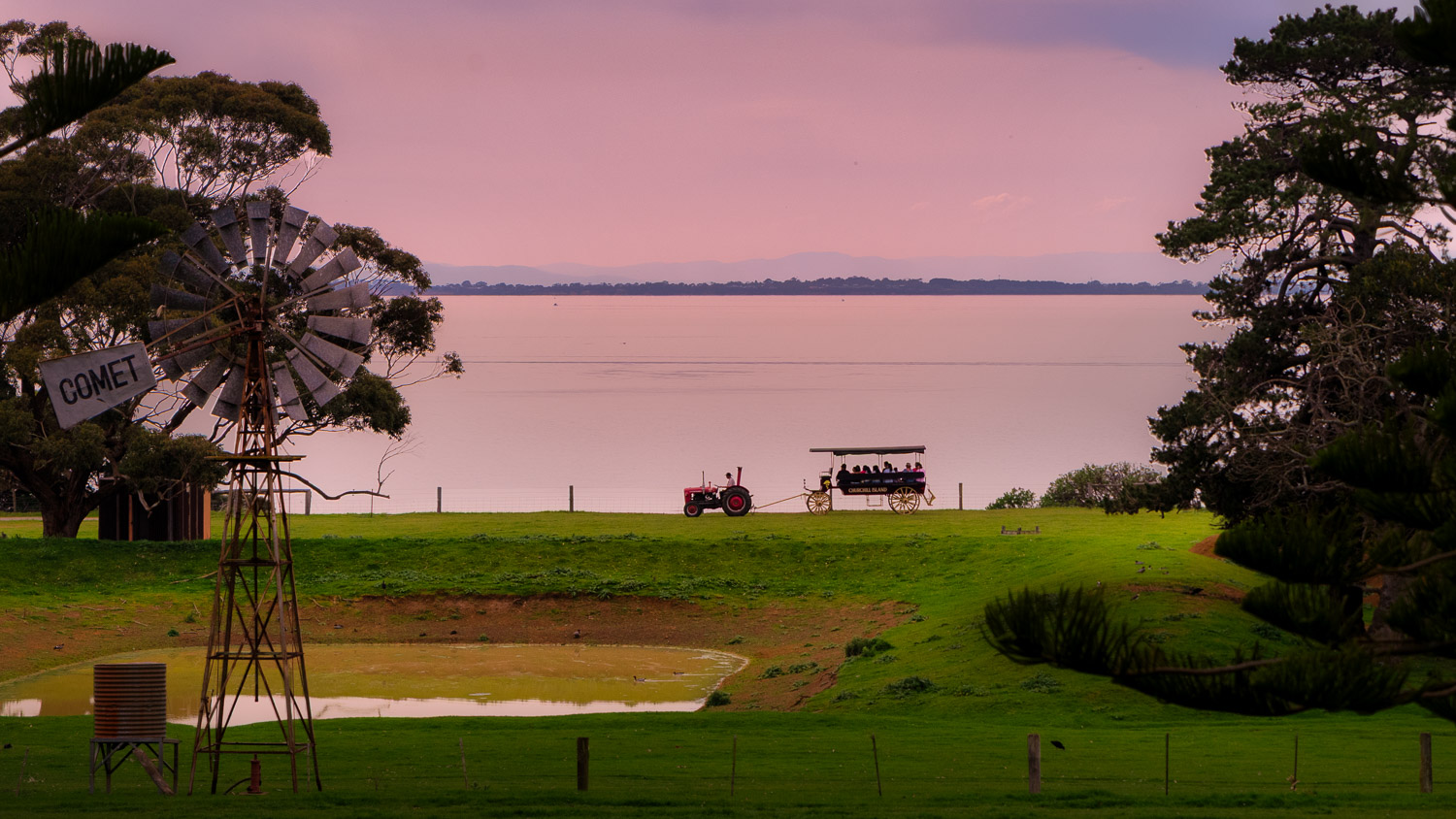
Beyond the farm, the island’s just plain pretty. There’s a walking track that loops around it, and strolling along you get some genuinely picturesque views.


The full-res photos are available on Flickr album below:
Leave a Reply