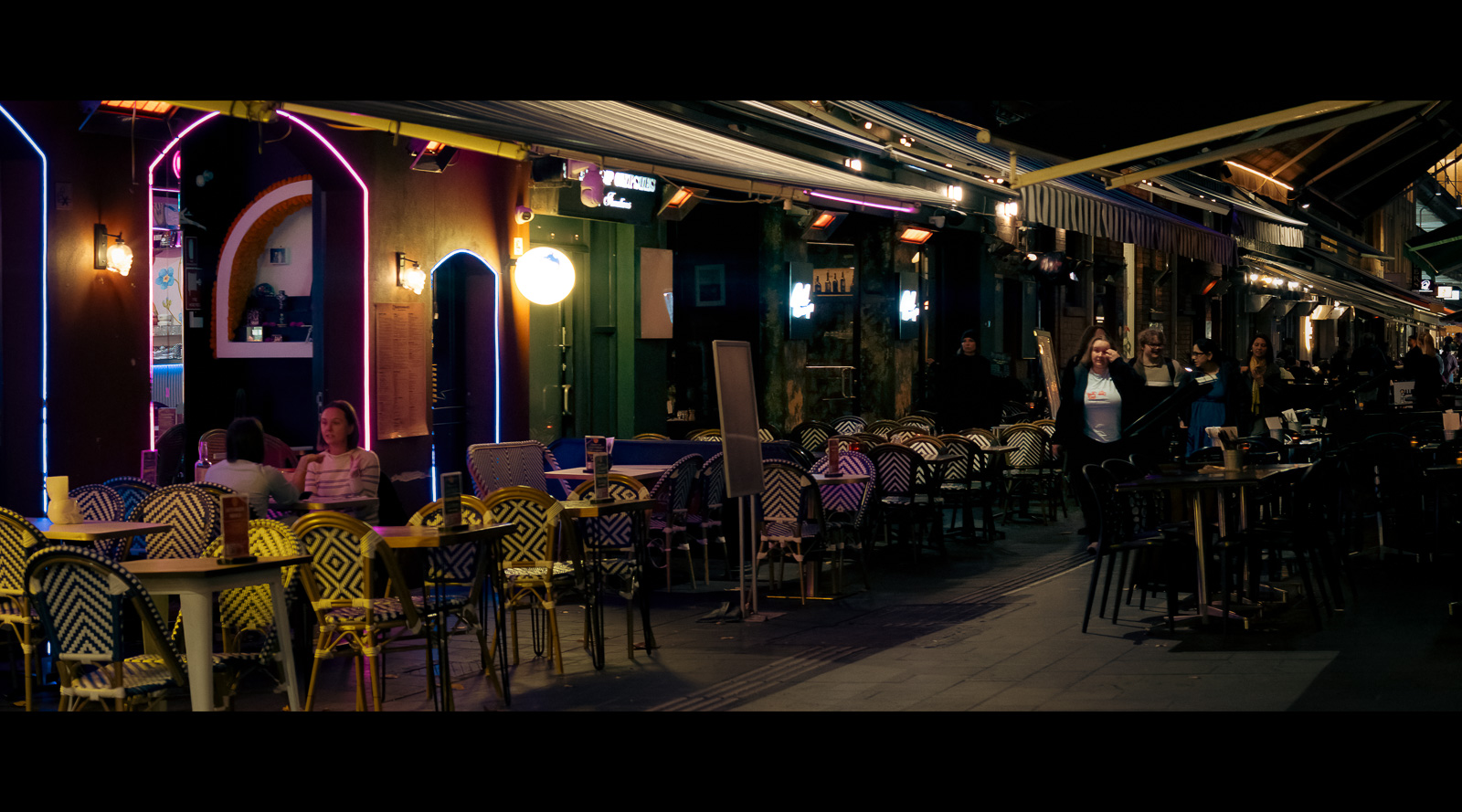
Cinematic Laneways
Do you enjoy watching films? Proper films — the kind made by a talented director. Not just casually glancing at the TV screen, but deliberately going to the cinema and immersing yourself in the atmosphere of the movie.
When we watch a film, we get swept up in the story, the acting, the direction, the soundtrack, the sound design. Sometimes we even notice the cinematography — and honestly, hats off to the brilliant Alik Sakharov for some truly stunning work. But there’s one part of filmmaking most people never really think about while watching a movie: the editors and the colourists.
Editors are fairly straightforward — they assemble the film scene by scene. But what exactly do colourists do?
Colourists are specialists in colour grading. You’ve probably noticed that some films, or individual scenes, are shot in particular colour tones that help create a certain mood or atmosphere. Science fiction is often presented in cool blue tones. Thrillers are frequently tinted dark green. Comedies tend to be bright and colourful, while historical films often lean into warm yellow shades — think 300.

The decisions about colour are, of course, made by the director. But bringing those ideas to life is the job of the cinematographer and the colourist. The cinematographer shapes the lighting on set and may use special filters or camera colour profiles — known as LUTs. But the final cinematic look is crafted later by the colourist.
Colourists work in dark rooms surrounded by several computer monitors, using programs like DaVinci Resolve, Adobe Premiere Pro, or Final Cut Pro. It’s a highly technical job, but also a creative one.
My film company consists of exactly one person. I’m my own director, cinematographer, editor, and colourist. Thank goodness I’m not the actor as well. I’m not making blockbusters just yet, but I enjoy the process.
After all that build-up, you’re probably expecting another video.
Not this time.
This round, it’s photos — but cinematic ones. I set myself the challenge of shooting stills on a video camera using a cinema lens, then grading them so they’d look like frames pulled straight from a movie.
So I wandered through the laneways of nighttime Melbourne with my Panasonic and an anamorphic lens, capturing various street scenes. Afterwards came the fun part: editing the shots into a cinematic style.
And colour wasn’t the only thing I had to wrestle with. There was the aspect ratio too.
Classic widescreen cinema format is CinemaScope — 2.39:1. A computer monitor is usually 16:9, while the camera sensor itself shoots in 4:3. The anamorphic lens squeezes the image sideways at a ratio of 1.33:1. So with all that arithmetic in mind, I started carving up the frames.
Straight out of the camera, the image looks squeezed horizontally in a 4:3 frame.

Then I cropped the top and bottom to turn it into 16:9 and worked on the colour grading.

And finally, I desqueezed it (yes, it is the technical term!) out to 2.39:1. The black bars top and bottom keep the image sitting nicely inside a 16:9 screen. Looks a bit like a movie still, doesn’t it?

The rest of the shots are in CinemaScope format.


A few I left in regular 16:9.


And a couple were even shot with a fisheye lens.


So — what do you reckon? Frames from a film that doesn’t exist. Would you go see a movie that looked like this?
For a proper feel, I’d definitely recommend viewing the shots in full resolution. Here’s the album on Flickr.
Leave a Reply